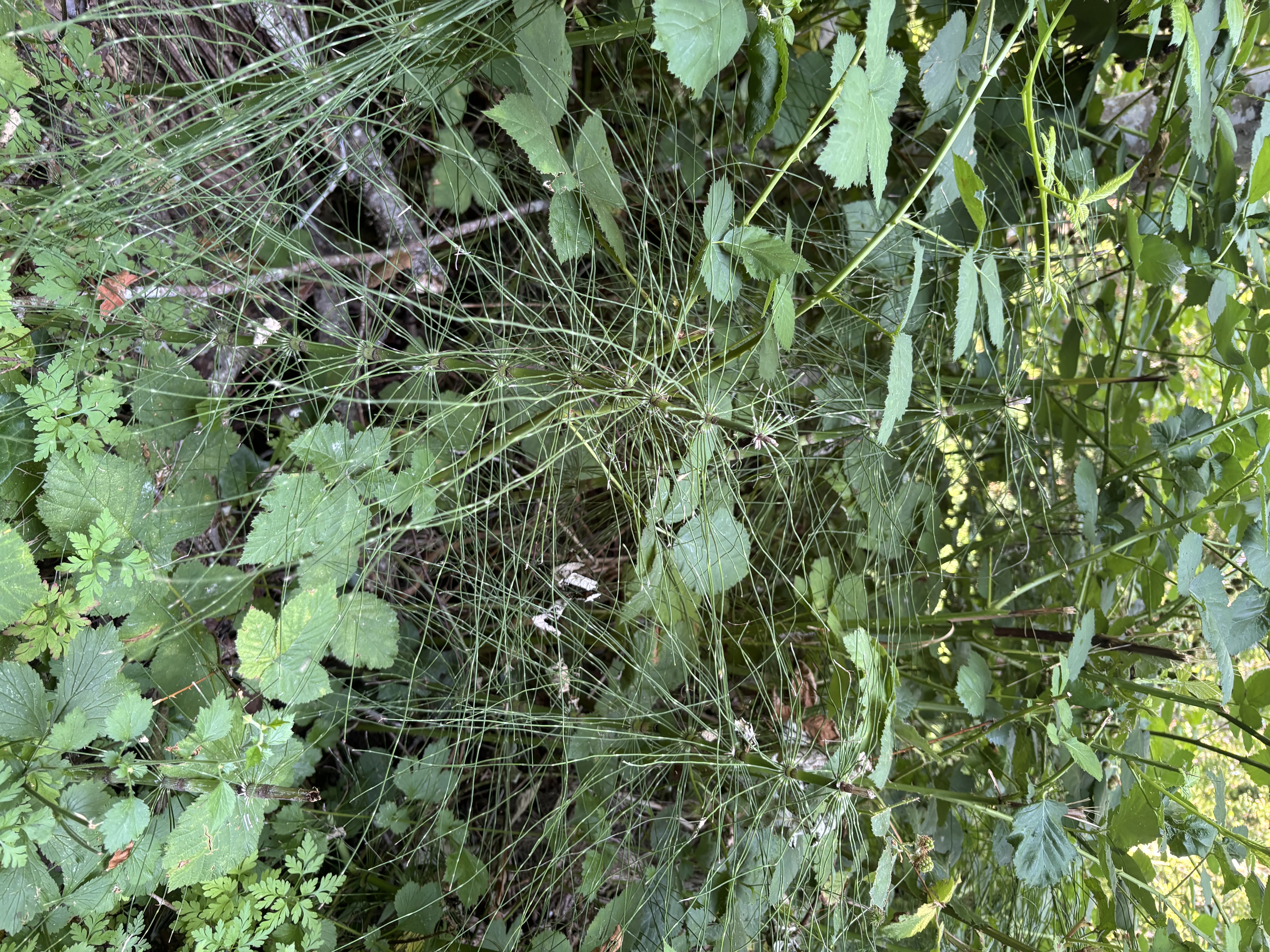
Equisetaceae (Horsetail or Scouring rush) is one of my favorite plant families. I first saw this plant after walking down a forested trail near a small, running stream in Portland, Oregon. I had never seen anything like it before. I didn't know what it was at the time but it instantly rang in my mind as prehistoric. I love anything that makes me feel like dinosaurs are abound! Turns out my initial reaction wasn't far off the mark! This plant family popped up in the timeline during the Carboniferous period (354-290 million years ago) (Files & Hill, 2024). This time period was characterized by tropical temperatures (heat & humidity) and most of the land covered by warm, shallow oceans (Hoe et al, 2011). It was a time dominated by giant insects like dragonflies and 2.6 meter (roughly 8.5 feet) long millipedes (Ashworth 2024). Horsetails during this period would have been the size of large trees and in abundance (Files & Hill, 2024). Nowadays, Equisetum is the only genus within this family that is alive and the tallest species only reaches about 3 meters (just under 10 feet) (Gilkey & Dennis, 2001). It's native habitat is found throughout North America, Greenland, Northeast China, Eastern Russia, Japan, and Central America however it has spread to many places around the globe (NC State Extension,n.d.). Horsetails typically found in moist habitats like wetlands, riparian zones, and vernal pools (Files & Hill, 2024). As a whole the species within this genus have stable or increasing populations wordwide and are listed by IUCN (2018) as a species of least concern.
Horsetails are vascular, seedless plants that are related to ferns. They have tissues that transport water and nutrients internally and reproduce via spores. They have two types of stems that are considered their most distinguishing characteristics for identification out in the field. The first type of stem is called a rhizome. Rhizomes are stems that grow horizontally along the ground either over the soil surface, or just below it (U&A Division of Agriculature, n.d.). You can tell rhizomes from roots as rhizomes have nodes and internodes. Nodes are points of active growth along a stem that may produce a flower, leaf, or branch. Internodes are the "empty" spaces in between the nodes. Rhizomes are also associated with "agressive" behavior which means that they spread quickly and can choke out other plants (NC State Extension, n.d.) The second stem is what makes up the "body" of the plant and is the primary photosynthetic organ (leaves are primary in most species). The stems are erect, hollow (except at the nodes), and jointed (Gilkey & Dennis, 2001). The leaves are either simple and look like small scales or they are slender, shaggy, and arranged in whorls at the nodes (Deur, 2014).

An interesting feature of Common and Giant horsetails are that they are dimorphic. This means that the plant produces two different stems from the same root system (OSU, n.d.) Stems are either fertile or sterile and are easy to distinguish from one another. The sterile stems have distinctive shaggy, bottlebrush looking leaves whereas the fertile stems do not. The fertile stems do have a super cool cone at thier tip called a strobolis which houses spores (Gilkey & Dennis, 2001). The sterile stems can be seen all season long while the fertile stems die off soon after releasing their spores (OSU, n.d).These plants can be seen in the early spring in the Pacific Northwest (PNW) (OSU, n.d).

The plants' rough texture is due to silica deposits in the epidermis. This characteristic has made it very useful as a fine sandpaper for woodworking and polishing/scouring objects (USDA, n.d.) Some other manufactoring and industrial applications of horsetails have been their use in dyes, cleaning products, toothpastes, protective clothing and detergents (USDA, n.d.).The reproductive shoots (stems) of the common and giant horsetails are considered edible and are likened to asparagus in texture and preparation (Deur, 2014). The plant has medicinal value as a diuretic and has a long history of use as such and still used today for this purpose.(Deur, 2014 & USDA, n.d.).
As mentioned earlier, its nature to spread aggressively via rhizome has earned horsetails its place on the "weed" list (OSU, n.d.) I find them absolutely beautiful though and a reminder of a time long before humans walked this earth. I am considering planting some Equisteum hymale (native to my area) in a container in my garden but am hesitant as I would hate to have it escape into my neighbors' yard. I absolutely adore horsetail species and think they are one of the most unique plants I've ever seen. I look forward to every spring when I get to see them on my hikes
All uncredited photos/illustrataions/figures/etc.are made by me (Whit)